This blog offers a behind-the-scenes look at ROFFEKE.
ROFFEKE is pronounced "rafiki" which is a Swahili word meaning "friend". 'Friendship, Fun, Freedom' is the motto of the ROck 'n' ROll Film FEstival, KEnya. The mission of ROFFEKE is to promote rock music in Kenya by dispelling rock 'n' roll myths and misconceptions via the medium of film. The Purpose of ROFFEKE is "Lighten the Burden".
ROFFEKE OFFICIAL SELECTION 2023 (Partial Listing)
Click laurels to watch the playlist.
ROFFEKE OFFICIAL SELECTIONS 2021
ROFFEKE OFFICIAL SELECTIONS 2020
ROFFEKE is proud to partner with Additude Africa
"Additude Africa promotes time credits as a means of encouraging the youth to be involved in community building activities in order to add a new dimension in their lives and make a positive contribution to their communities."
ROFFEKE is proud to partner with ipitch.tv
"Looking for a way to pitch your idea for a television show or movie? Ipitch.tv offers a next generation platform for creators of original ptiches for TV, film and digital media to connect directly with Hollywood producers and studio executives."
ROFFEKE Values
Friendship (networking), Fun (experimentation), Freedom (purpose, empowering, transparency)
SUBMIT YOUR FILM TO ROFFEKE!
ROFFEKE logo by Jozie of Kenyan band 'Murfy's Flaw'
ROFFEKE is a member of the Universal Film and Festival Organization
ROFFEKE: In your www.fabrica-do-terror.com interview, you say that at first, Afterlink "was supposed to be an interactive film, and we'd still like to try to make it. It's possible with the technology we have now. The idea would be for the person to be able to access scenes from the film that were cut, talk to the actors in real time, access certain content that the viewer only knows exists through the Easter eggs that we hide in the film. The goal would be for us to build a community of sci-fi and horror through this real-time interaction with the audience." You also mention that "Heather Pettit, who works in video games, created our ghost." If you were to make a video game of Afterlink, what would be the objective of the game, the game mechanics, etc?
CATARINA: The computer in our film is a window to connect with the audience, and symbolically, our soul. After Link was supposed to be an interactive film where the User would watch the film in a browser (hopefully connected to the internet), and the whole page would be the film seen from the other side of the computer (not just a screener).
We shot the whole film from two perspectives: the cinematic and the interior of the computer, so we could have a film for theatrical exhibition and also another one for the digital world.
Inside the computer, there are these files where you could interact with and find scientific research that explains a bit more of the plot and the possibility of parallel dimensions, inter-existing within the web and spiritual theories of our soul, as well as access to behind the scenes. We also left a few easter-eggs you should find based on what was happening on the other side of the computer to open certain computer files. Finally, a bottom text bar would also be available to write directly to the characters, David and Marta. We’ve recorded 360º of our cast to use exclusively for this film where keywords, prompts and a.i. would be used for their facial expressions.
In After Link, Marta and David encounter a ‘ghost’ which is never explained if it is an error in the code, an A.I. trying to gain consciousness or the actual soul of a girl who Marta knows committed suicide in their last year of University and could be following them/ living or stuck throughout the web. In the interactivity version, you (the user) are the real ones talking to David and Marta, who you would see typing, but the one replying would be A.I. in a way to ask the world this simple question: Is technology becoming more like us, or is it us becoming like them?
Unfortunately, we did not get enough funding to pay software engineers in order to finalise the interactive version of the film. Anyone who would like to embark on that, please feel free to send us a message via Instagram or Facebook: @afterlinkofficial
Tomorrow (October 24th) is the beginning of Global Media and Information Literacy Week. The 2024 theme is “The New Digital Frontiers of Information: Media and Information Literacy for Public Interest Information”. It will address the transformative impact of emerging technologies such as Generative Artificial Intelligence and the new generation of digital content creators on the production and dissemination of public-interest information, highlighting both opportunities and risks." https://www.unesco.org/en/articles/celebrating-global-media-and-information-literacy-week-2024?hub=66833
I uploaded to notebooklm a document that has the first two laws of UNESCO's five laws of media and information literacy, and ROFFEKE's motto (Friendship, Fun, Freedom) and mission (to promote rock music in Kenya via film by dispelling myths and misconceptions about rock music). Here are some excerpts from the podcast:
00:18 ...rock music, especially in Kenya, isn't exactly mainstream...ROFFEKE is providing this entry point. It's a place where people can experience a culture and art that they might not ever come across otherwise.
00:37 ...when I hear barriers to information I usually picture Internet censorship but simply not being exposed to a certain type of music...that's a barrier too.
00:50 ...ROFFEKE showcases rock music through film...suddenly those financial and geographical barriers start to disappear. The genre becomes open to people who might never even have thought of listening to rock before.
1:25 ...music, film, these are powerful ways to share information too...stories woven into them, emotions, ideas that can actually challenge how we see the world and even build bridges between cultures. ROFFEKE is using that power to dismantle common misconceptions about rock music.
2:08 ...ROFFEKE becomes a space for people to come together, bond over this music they love and just express themselves without holding back."
I (Mildred Achoch) compiled a mental health document comprised of excerpts from ROFFEKE interviews, uploaded the document to Google's Notebooklm which then generated a podcast based on the information in the document. Below is the podcast and the interview excerpts, with links to the full interviews.
Interview: IVA ("Run" producer/singer/performer) and Camilla Natta ("Run" music video director)
ROFFEKE: IVA and Camille, how do you find your inner strength in a world and an industry that can be quite challenging for women?
CAMILLE: I’m excited to see things are changing in our industry, I think it’s an inspiring time to be a woman in our industry right now. While only 22% of Hollywood directors are currently women, we’re still making changes faster than other industries like neurosurgery where less than 10% of neurosurgeons are women. I have made an effort to surround myself with smart women in my industry (like IVA) who have been so generous in sharing their experience and supporting me. Because of the importance of mentorship in our industry, we still have some way to go. When you consider that twice as many main characters are male than female and then you break it down further, you see that in films with at least one woman director and/or writer, females comprise 57% of protagonists, whereas in films with exclusively male directors and/or writers, females only account for 19% of protagonists, it becomes very apparent that, as women, we still have great need of a greater pool of role models and it’s so important to support each other. I’m grateful to be part of the female directors who can lead the way for the next generation of filmmakers, I want to be there for them, to encourage them.
The daily practice of showing up is also something IVA and I worked on together. We’ve had a ritual of warming up our voices together every morning for the past 18 months and it just set us up for success. It’s kind of like meditation, but we did it together, so it added a dimension of showing up for another person so you double up on your accountability and also your sense of achievement as a team.
IVA: We had a beautiful, wild ride creating this video together, and we have collaborated many times, which made our working relationship even more powerful on this film, both when things went right and if things went wrong - like losing a much desired makeup artist at the last minute or facing a large budget and finding ways to make it smaller while holding true to the vision. We had inner strength from a mutual trust and respect for each other’s artistry, and from having each other to lean on. Camille and I have a very strong friendship. We lift each other up when our self esteem is damaged by the industry, and help each other navigate through when life and work becomes challenging. We have a pact to be fully honest with each other, and we can hash through differences and fight sometimes and then discuss openly what happened with no hard feelings. As a musician, I focus on sharing my truth in the most effective way I can, which I find is through my music, and Camille helped me emanate a deeper, stronger version of myself in this video. A few years ago I lost my mother suddenly, and was also in a romantic relationship where I was a victim of domestic abuse for many years. I was grieving for a long time and felt somewhat defeated, and Camille helped me feel ready to “Run” with passion again. Camille and I also provided firsts for each other with this video, she as lead director and I in having the creative direction of someone of Camille’s caliber and deep knowledge of me as an artist. I was able to look into the camera with my full being, unafraid of being seen. That has given me a new perspective on my artistry, and about who I am. I know most of all that standing together is our strength, and I am grateful to have a friend and colleague like Camille who gives it to me straight and loves me with all her heart, as I do her. I hope that as two women creating this music video together we will be able to reach many more people and inspire other women to realize their creative visions fully, and as often, as possible.
Read the full interview HERE: http://kenyarockfilmfestivaljournal.blogspot.com/2023/03/interview-iva-run-producersingerperform.html
Interview: Dr. Lisa Spencer aka llysa - writer of Bad Syne
ROFFEKE: Bad Syne begins with the graffiti artist saying: “if there are more public places specifically allotted to the public creativity and the public's idea of whatever they want to do with art...in Europe, it’s a lot easier, just walk up to a wall and write on it, no problem, it’s legal.” There is always a tension between freedom of expression and those who want to regulate art. What are your thoughts about this?
DR. LISA SPENCER: The regulation of art is dangerous. In history, we see artists being persecuted because they often were brave enough to express commentary on social and political mores and structures. One of the purposes of art is to make change in thought and in the action of art, the world continues to open up, change, and heal. The freedom of expression should only be regulated by consideration for others in terms of, for example: racism, sexism, exploitation, etc. Governments...have banned forms of religion, language, and art, dance and song, punishable by death. Art’s significance is vast, but its freedom plays a role in human freedom and human rights.
Read the full interview HERE: http://kenyarockfilmfestivaljournal.blogspot.com/2024/01/interview-dr-lisa-spencer-aka-llysa.html
Interview: Dr. Nolan Stolz - composer of "Gravitation" (Part 2)
ROFFEKE: Advice for musicians, music scholars and creatives in general?
DR. STOLZ: My advice depends on their goals. For creatives not relying on their work as their primary income, I say "create the art that you want to exist in the world: music you want to hear, films that you want to see" and so on. If it's mainstream, great! If it's experimental, great! I wish that could be the case for all, but if you are trying to make a living at your art, diversify by finding as many ways to earn an income by providing a needed service. This means you may need to play music you don't like, do lighting for a show you don't like, etc. Doing this is a business choice, not an artistic one. Both are perfectly acceptable, and it depends on the person and the balance that is right for them...
For scholars, know now that you won't make much money off of book sales or royalties. Income from scholarship will come in other ways, such as a teaching position and invited talks. My advice is "write the book [or article, etc.] that you believe should exist but doesn't." There is so much joy in knowing your contribution serves its purpose. It pays off in other ways, sometimes not until years later. If I hadn't written those essays for that collection (which was essentially for free—my payment was a physical copy of the two-volume book), I probably would have never gone to England, France, or Sweden to lecture on Black Sabbath, written the book on Black Sabbath, gotten a personal email from Ozzy Osbourne. . .
Read the full interview HERE: http://kenyarockfilmfestivaljournal.blogspot.com/2024/01/interview-dr-nolan-stolz-composer-of_8.html
Interview: Federico Santini - composer of "Boysong" from the film Quest for Feilong (Part 1)
ROFFEKE: In your “About Me” page on your website, it is mentioned that you teach piano and music education at middle schools, high schools and music schools. What would you say is the importance of music education in middle school and high school?
FEDERICO SANTINI: I believe that musical activity has an important contribution in strengthening cognitive, emotional, linguistic, motor and relational skills, especially in developmental age, where the brain is still in the training phase. This is why I believe music education in schools is important...the music, by involving the emotional sphere of the individual, especially at an age where this is not yet fully mature, guides him to greater awareness and maturation of the same...Music is also often recognized as having a social and aggregative role. In fact, I have participated in several projects whose main objectives include not so much the students' musical performance but socialization and integration in areas and situations of social hardship. Music urges us to listen to others in order to work in unison and each member of the group or orchestra is important, each one with their part. In essence, I believe that musical activity within schools includes various aspects and substantially integrates the individual's education."
Read the full interview HERE: http://kenyarockfilmfestivaljournal.blogspot.com/2024/02/interview-federico-santini-composer-of.html
Interview: Simone Massi - Director of "in quanto a noi" (From our side)
ROFFEKE: In these hectic times, how do you take care of your mental health?
SIMONE: I try not to follow the media, not to rush. And then I try to take the good in life, accepting defeat and respecting others.
Read the full interview HERE: http://kenyarockfilmfestivaljournal.blogspot.com/2024/04/interview-simone-massi-director-of-in.html
ROFFEKE: During the 2020 lockdown, the world saw how Italians stood in
solidarity with each other through music on their balconies:“In
the flat in front of me, a couple with a small child appeared,”…“The mother
carried him in her arms while the father played a children’s musical toy. They
waved over at us and we waved back. We’ve never met.” (“Balcony singing in solidarity spreads across Italy during lockdown” The Guardian).
Did the lockdown increase your productivity as a composer or
did it lessen your productivity? How did you cope during this
challenging time? How do you take care of your mental health?
FEDERICO SANTINI: At the school where I worked we started with remote lessons immediately,
so the teaching activity never stopped. Unfortunately, not long before I
had started having breathing problems which worsened during the
lockdown, not being able to rely on medical care. At a certain moment,
as directed by the doctor who was worried it could be Covid (the
symptoms of the disease at that time were not yet very well known), I
had to isolate myself in a couple of rooms for about a month and my
activity during that period had stopped completely. During the rest of
the lockdown my composition activity remained more or less the same as
before, even if the cooperation with the musicians who had to record
the songs from the soundtrack took place online.
Teaching activity became more difficult during the lockdown because the
remote learning triggers a series of critical issues. Feedback with
students is more difficult on screen. It is difficult to understand if
the topics explained are clear and it is also more difficult for the
students to interact with the teacher.
For me in that period, communication with loved ones was very important,
especially with the Chinese harpist, Siyun Shen, whom I spoke about
above [in part 1], with whom I had established a deep friendship. Especially during
my period of isolation, Siyun was very close to me and we spent hours
every day communicating via Whatsapp, especially with messages since my
breathing problems made verbal communication a little difficult.
ROFFEKE: Your thoughts on artificial intelligence and music?
FEDERICO: As far as I'm concerned, I don't use artificial intelligence in
composition, I like to take care of every aspect personally. So far I
haven't found any really interesting compositions created by artificial
intelligence. I think it does well in low and medium-low level
compositions but so far I haven't heard any interesting music. However,
when A.I. finally will be able, to write some beautiful music, and I
think it's a matter of time, I will be very happy to listen to it. But I
believe that there are big risks for composers due to the numerous
instances where A.I. has been involved in matter of plagiarism.
Artificial intelligence operates without awareness of what it means to
copy a work, and therefore, which is why many artists are complaining
about this.
ROFFEKE: Advice for aspiring composers?
FEDERICO: First of all, I would recommend an in-depth study of the subject.
Searching for scores and analyzing the songs you like is a useful tool.
Look for qualified teachers to take lessons from. Studying alone is not
enough, it is useful to play in many different contexts and enrich
yourself with many experiences. It was useful to me, in addition to
playing in classical ensembles, being part of rock and pop bands,
accompanying Gospel choirs, and so on. I think it is important to make
yourself known by interacting with other people as much as possible.
Avoid contexts for which you don't have time to prepare, you risk making
a bad impression. I would also recommend being fair to other
composers and protecting your works before sending them out.
ROFFEKE: There are new artificial intelligence tools that, with a
prompt, someone can create animated music videos or short films within
minutes. What are your views on artificial intelligence? As a stop
motion animator, what are the ways you see artificial intelligence being
of use? What would you never use artificial intelligence for when it
comes to animation?
PETER Böving: My sense is that AI will play a significant role in the creation of
computer-generated animations. It seems like there won't be a stone
left unturned. I can't elaborate much further as I have given my heart
to the analog approach. The greatest strength of stop-motion animation
lies in its analog nature, allowing one to potentially smell the
materials and adhesives used in a film. Naturally, AI is gradually
finding its way into my film and audio software without me actively
installing anything.
However, something often overlooked in creative processes is that
experimenting with mistakes often leads to entirely new ideas, possibly
even the best ones! This only works when one has previously tinkered
with the controls oneself. AI works largely flawlessly and doesn't
reveal any vulnerabilities. But there are aspects of AI that I already
wouldn't want to do without: the potential in the area of image scaling
and restoration.
I will consciously keep artificial intelligence away from sound and
music production, though. The evolution in this field has taken peculiar
turns even before the era of AI: Instruments are being played live less
and less, and arranging is often done using modular systems. However,
in music, my observation is that it's not as easy to deceive as in the
film medium. Those who merely 'claim' or hide behind 'effects' will be
exposed much quicker by the human ear!
ROFFEKE: What are you doing in your own life to prevent wasting your food?
PETER: The whole program, I think: Planned shopping, making use of
leftovers, proper storage, and minimizing waste or composting. However, I
also know no other way: My parental home has greatly influenced me in
this regard. We threw out little, whether it was money or food. Despite
having the financial means, at our home, recycling came first before
considering buying something new (of course, food was not recycled:).
Probably, the post-war years, which strongly influenced my parents,
still play a role here.
What I have newly discovered for myself, though, is the 'regrowth' of
vegetable scraps. In our kitchen, there are little water glasses in
every corner where leeks or vegetable onions grow again. That a
harvested plant sprouts again is almost a miracle! After 4 weeks, there
are fully grown, harvestable plants in the glasses again. Anyone who has
ever grown leeks in their garden would have reason to doubt now. After 4
weeks, not much has happened in the home garden bed with a young plant,
to be honest.
(Look out for part 3 of the interview. You can read part 1 of the interview HERE)
ROFFEKE: You have done a 2020 “COVID” version of your
composition “Gravitation” which is “an open instrumentation piece for any 5 to
8 performers” but in the Covid version, you overdubbed all the parts and used
video to present it “in a way impossible in live performance.” I’ve been trying
out various artificial intelligence tools, including the ones that make music.
I must say that I’m very impressed with them and at the same time, I am
conflicted because it seems as though something important is being lost in the
process. What are your thoughts on artificial intelligence? Would you consider
an “AI” version of“Gravitation”?Why yes and/or why no?
DR. NOLAN STOLZ: It sounds like what's being
"lost in the process" that you are not satisfied with is the
algorithm itself, which is likely hidden behind an easy-to-use interface.
Before AI became widespread, the term we'd use for composing music in this
manner was "algorithmic composition." The art is in the creation and
execution of those algorithms with a result that is satisfying to the composer.
An early algorithmic piece that I composed required the user to type in four
characters on the keyboard—letters, numbers, symbols—the user's choice. The
program I wrote took the ASCII code of the characters that the user entered and
set off a series of events, which were then converted into musical sounds. The
particular program I wrote made it sound a certain way, but I could have made
it sound simplistic—perhaps even "pretty-sounding"—with limiting it
to a simple scale and limiting the rhythms to imply a simple groove; I could
have made it microtonal to avoid it from resembling Western tuning system and
with bizarre/random-sounding rhythms; I chose somewhere in the middle where it
was atonal and had unusual rhythms—but nothing too crazy. I titled it
"Love is a Four-Letter Word."
2018 SC Upstate Research Symposium: Nolan Stolz Rock Orchestra
I would love to create an AI version of Gravitation or
have someone create one. The score for Gravitation provides quite strict
instructions for timings, loudness, and frequency, but the sounds themselves
could certainly be AI-generated. In other words, instead of choosing guitars
and keyboards as the instruments used, AI would create the timbres. Some of the
sounds are supposed to be wood against wood, metal against metal, and wood
against metal, so perhaps AI could be used to control robotics physically
hitting those materials. At least the timing would be incredibly precise!
ROFFEKE: You have authored “Experiencing Black
Sabbath: A Listener’s Companion” and have also written many scholarly works on
rock, specifically, progressive rock. With all the “more” important subjects
that need to be researched – climate change, a cure for cancer, world peace –
why spend so much time, energy and resources doing research on progressive rock
and Black Sabbath?
DR. STOLZ: The simple answer would be is that I wasn't
trained as a climate scientist, a cancer researcher, nor in politics. I began
my music studies very young, and I knew that's where I was headed. Those things
are important to me, but we live in a world of specialists, and I doubt I'd
have enough impact on those issues with my skill set. However, I can certainly
use my skills to point others to think about those issues, and maybe those with
the right skills can make a bigger impact than I ever could (directly, I mean).
For example, I talk about how a song such as "Into the Void" (1971)
is about pollution, how "War Pigs" (1970/1) is still relevant today,
and so on.
There are many Black Sabbath songs that would have a large impact on
listeners if they knew what the songs were about. So, if I can do my small part
by pointing them to songs that addressed these issues over 50 years ago and yet
are still relevant, then I think that's using my skills for the greater good in
the only way I know how.
The Emergence of Heavy Metal and Progressive Rock in Black Sabbath's Music from 1969 to 1971 (Stolz)
There are other issues that are also important to me
that I believe I can make an impact, which hopefully inspires others to do the
same, and, after time, I hope will make a significant impact. For example,
poverty, hunger, and homelessness are issues that have always been ones that
tug at my heart. If I can do a small part by buying some school kids some basic
necessities and provide food, clothes, and personal hygiene items to a homeless
shelter, it's wish others will follow suit. For example, just last week, I
emailed all my colleagues at work to see if anyone else would like to buy some
backpacks for students at my wife's school. Many of these kids come from
families that cannot afford one, or if they have one, they are taped together
and falling apart because they cannot afford to get a new one. I live in a
neighborhood that suffers from poverty, so I see it on a daily basis.
ROFFEKE: Your About page on your website
https://nolanstolz.com says you are a “Composer, Scholar, Percussionist/Drummer,
and Music Professor.” One could be criticized for not focusing on one career or
lane. How do you juggle the different hats you wear? What are the advantages of
being involved in diverse aspects of music/creativity? (Check out Dr. Nolan Stolz's answer in part 2 of the interview).
I was interviewed by Irene Mugo of the Daily Nation about how artificial intelligence is impacting me as a creative. I mentioned that when it comes to AI, I am an optimist but I am also aware of the drawbacks.
Some of my interview answers did not make it to the article so I will share them here. Regarding the drawbacks, I said:
One challenge posed by AI in the creative space is bias. Most, if not all, AI tools are trained on data that is largely Western. This issue is being addressed and corrected but more still needs to be done to ensure that AI tools are representative of diverse cultures, philosophies and aesthetics. Another challenge is the disruption that AI will cause and is causing in the creative space. Many creative jobs will be rendered obsolete or will change drastically due to AI. This presents both a threat and an opportunity. Creatives who upskill and learn to use AI to complement their creative process will be able to ride this AI wave rather than drown in it. I also think there is a big opportunity for educational institutions to begin incorporating topics such as "AI and Creativity" into their curriculum."
I subscribe to David Shapiro's YouTube channel and in his video titled "AGI Revolution: How Businesses, Governments and Individuals can Prepare", he outlines some of the horrors of AI. In the section about "Forever Jobs" (minute 26:14), he points out that even jobs such as "childcare, entertainment, and hospitality" which are deemed "likely to persist due to intrinsic human desire for human-performed services" will not be spared by the AI monster.
I am a fan of psychological horror, where the monster is invisible and therefore more horrific because our imagination becomes very helpful in filling in the blanks.
Artificial Intelligence is that unseen monster that, according to some experts, may literally end the world.
In his video (minute 24:28) David Shapiro talks about Emotional Adaptation, "The range of emotional responses people may experience in response to significant changes..." He lists some of these emotions: "uncertainty, fear, anger, existential dread, anxiety, hope and awe."
One of the interview questions that Irene Mugo asked me was whether artificial intelligence will threaten creativity. I hope my answer to her question will inspire hope and awe in all creatives as we face the wonders and horrors of AI.
As an optimist and as a creative, I do not think AI poses a threat to creativity. Yes, AI can mimic creativity and sometimes can produce creations that are better than what human creatives can produce. However, this in no way is a threat to creativity. The creativity of AI does not take away my creativity. Comparison is the enemy here. I create because it gives me joy, it is a way for me to express myself, to communicate and to create value. There are other creators - both human and AI - who can create things that look or sound better than my creations. However, there is only one me, and no one - whether human or AI - has my unique perspective, experiences, values and beliefs. One could argue that soon, human beings will be able to upload their consciousness to robots and duplicate themselves...but that is a conversation for another time! To quote lines from a song called“Sons of Robots” by one of my favourite Kenyan rock bands "Rash":
“with all of their technology, they can feel no more.”
I think as long as we creatives continue to feel, we will always be a step ahead of artificial intelligence.
ROFFEKE Bot: ROFFEKE values experimentation as part of its
core principles. It believes in the power of trying new things, pushing
boundaries, and exploring innovative ideas. Through experimentation, ROFFEKE
aims to create unique and groundbreaking content in the world of TV, film, and
digital media.
(Below is Diego Serebrennik's reading of his poem, accompanied by a video created by AI)
Mildred: Tell me more about ROFFEKE and experimentation
ROFFEKE Bot: ROFFEKE embraces experimentation as a
fundamental aspect of its mission. It encourages filmmakers and creators to
think outside the box, take risks, and explore unconventional approaches in
their work. By fostering an environment of experimentation, ROFFEKE aims to
push the boundaries of storytelling and challenge traditional norms in the
industry. This allows for the discovery of fresh perspectives, innovative
techniques, and groundbreaking narratives that captivate audiences and leave a
lasting impact. Through its support of experimentation, ROFFEKE strives to
empower filmmakers to unleash their creativity and bring their unique visions
to life.
(Below is Martin's reading of his poem "African Drummer" accompanied by a video of his avant-garde drumming)
Mildred: Tell me even more about ROFFEKE and
experimentation
ROFFEKE Bot: Certainly! ROFFEKE's commitment to
experimentation goes beyond just encouraging filmmakers to think outside the
box. It actively seeks out and supports projects that push the boundaries of
traditional storytelling and explore new artistic territories. ROFFEKE believes
that experimentation is essential for the growth and evolution of the film
industry.
Through its various programs, workshops, and seminars,
ROFFEKE provides a platform for filmmakers to learn, collaborate, and
experiment with different techniques, styles, and genres. It encourages them to
take risks, challenge conventions, and explore innovative ways of storytelling.
ROFFEKE also values the feedback and input of its audience.
It recognizes that experimentation can sometimes be polarizing, with some
viewers embracing the boldness of new ideas while others may find them
challenging. However, ROFFEKE believes that through open dialogue and
constructive criticism, experimentation can lead to new perspectives and a
deeper appreciation for the art of filmmaking.
By embracing experimentation, ROFFEKE aims to foster a
vibrant and dynamic film community that celebrates creativity, diversity, and
the exploration of new frontiers. It strives to be a catalyst for change and a
platform for filmmakers to showcase their unique visions and push the
boundaries of what is possible in the world of cinema.
I hope that provides you with a deeper understanding of
ROFFEKE's commitment to experimentation. Is there anything else I can assist
you with?
(End of chat)
In September, I (Mildred Achoch) experimented with the
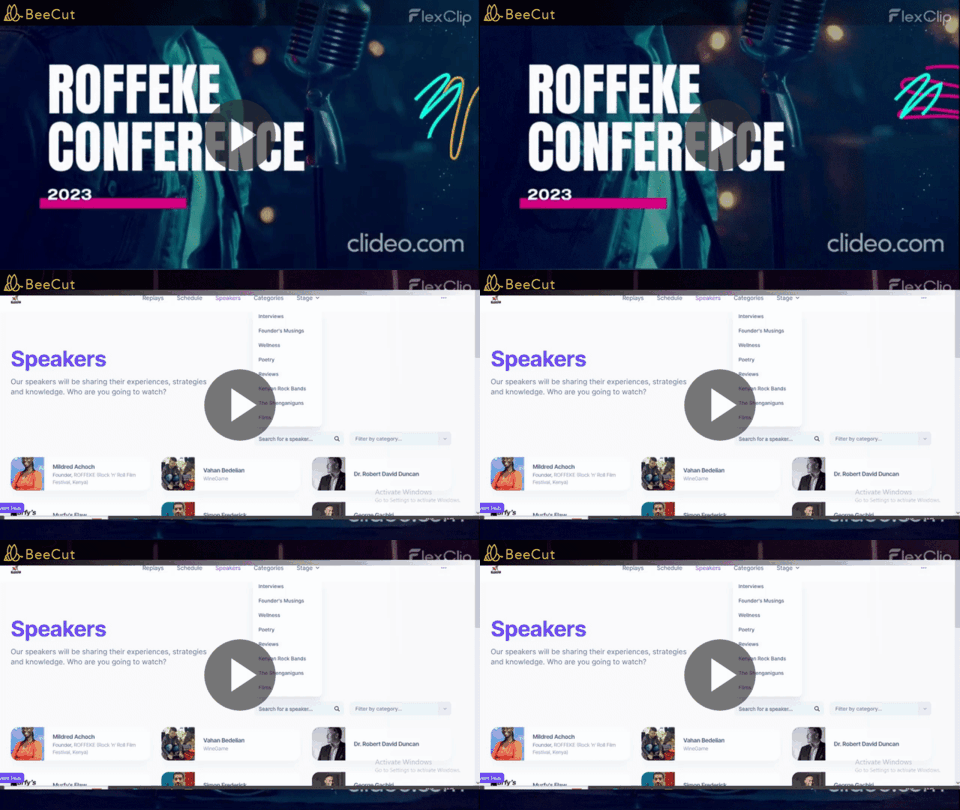
platform Heysummit, where I organized ROFFEKE Conference 2023. I found the platform
to be easy to use and support was offered whenever I had questions or problems. Below is a short video of screenshots from ROFFEKE Conference 2023.
I (Mildred Achoch) created a ROFFEKE Chatbot courtesy of Chatbase.co, using content from the ROFFEKE blog. I then asked the chatbot some questions. Below is a sample of the answers:
What is ROFFEKE?
ROFFEKE, pronounced "rafiki," is a rock 'n' roll
film festival in Kenya. Its mission is to promote rock music in Kenya by
dispelling myths and misconceptions through the medium of film. The festival
showcases local and international rock 'n' roll films and music videos for
educational and entertainment purposes. It also organizes workshops, forums,
and seminars related to various aspects of rock music and the film industry.
Additionally, ROFFEKE provides a platform for emerging and established rock
bands, both local and international.
What does ROFFEKE do?
ROFFEKE has several objectives. Firstly, it showcases local
and international rock 'n' roll films and music videos for educational and
entertainment purposes. Secondly, it organizes workshops, forums, and seminars
related to various aspects of rock music and the film industry. Lastly, it
provides a platform for emerging and established rock bands, both local and
international. These activities contribute to the promotion of rock music in
Kenya and help dispel myths and misconceptions associated with the genre.
How can I get involved with ROFFEKE?
To get involved with ROFFEKE, you can consider a few
options. Firstly, you can submit your own rock 'n' roll film or music video to
be considered for the festival. You can do this by visiting the festival's
Filmfreeway.com page and following the submission guidelines. Secondly, you can
attend the festival as an audience member and support the showcased films and
bands. Lastly, you can explore opportunities to volunteer or collaborate with
ROFFEKE by reaching out to their team directly through their official channels.
Remember, being part of the rock community and showing your support for the
festival's mission are great ways to get involved with ROFFEKE.
Artificial Intelligence. As a techno-optimist, I feel like a surfer who is looking at the biggest wave ever. Yes, there is the ever present danger of “wiping out”, of the artificial intelligence wave wiping out humanity – or humanity as we know it. More knowledgeable people than I have spoken, written and made films or documentaries about the negative side of artificial intelligence.
Kenyan rock band “Rash” sung about “Sons of Robots”
Wearable Android (#ROFFEKEOFFICIALSELECTION2015) by Keita Nishida is a fun look at the human-technology relationship.
Me? I am a techno-optimist. Frankie Valli and The Four Season sung in Walk like a man, “The world isn’t coming to an end” and REM pointed out: “It’s the end of the world as we know it (and I feel fine”)
In May, I watched a webinar by 6 seconds titled “The Inside Path - Trust and Optimism for the Future”. Artificial Intelligence was one of the things that was mentioned as causing people anxiety. The three sub-topics that were covered in the webinar were:
•The role of optimism in creating a positive outlook on the future and fostering hope and excitement about what’s to come.
•The importance of trust in building strong relationships and communities that can support us in achieving our goals.
•How combining trust and optimism can create a sense of empowerment and agency in shaping our own future.
6 Seconds is “a non-profit organization whose mission is to increase the world’s emotional intelligence.”
I am a big fan and student of Emotional Intelligence. I thought Emotional Intelligence was one area that humans would dominate for a long time. Well, I recently learned about Heypi.com from the YouTube Channel “AI News Daily”. The title of the video says it all: "Hey Pi - The Best "Real" Conversation I've Had with an AI Chat Bot"
I tried it out and used Heypi.com to get a review of some sentences from my short story about The Shenganiguns titled “Office Romance”. Watch it here.
One of the things that is causing concern about the fast-pace of AI development and deployment is that there isn’t adequate regulation. There is concern that AI will excarcerbate already existing problems like bias. Enter Claude, an AI that takes into consideration the Declaration of Human Rights. I learned about it from this YouTube video titled “Claude: The Quantum AI that Surpasses ChatGPT (AI with a Conscience!?)".
On December 10th, 2022, ROFFEKE celebrated Human Rights Day with a YouTube playlist of short films and music videos that highlight the declaration of human rights. You can watch it here. Some of the films in the Human Rights playlist are also in the ROFFEKE Borderless Africa playlist, which is part of the Africans Rising “African Liberation Week” events taking place between May 22nd and May 28th.
During Mozilla Festival (March 20th to 25th) my session, titled “Techno-optimism through ROFFEKE rock ‘n’ roll films” featured the Human Rights YouTube playlist that showcased how tools such as YouTube playlists can help people in the global south participate in closed off or not easily accessible spaces. Mozilla Festival had some AI-themed sessions and even some of the non-AI themed sessions did touch on AI in terms of ethics and mental health.
So what is my current stance on Artificial Intelligence? Well, I am riding the AI wave with both excitement and caution. Surf's up!



 Posts
Posts