This blog offers a behind-the-scenes look at ROFFEKE.
ROFFEKE is pronounced "rafiki" which is a Swahili word meaning "friend". 'Friendship, Fun, Freedom' is the motto of the ROck 'n' ROll Film FEstival, KEnya. The mission of ROFFEKE is to promote rock music in Kenya by dispelling rock 'n' roll myths and misconceptions via the medium of film. The Purpose of ROFFEKE is "Lighten the Burden".
ROFFEKE OFFICIAL SELECTION 2023 (Partial Listing)
Click laurels to watch the playlist.
ROFFEKE OFFICIAL SELECTIONS 2021
ROFFEKE OFFICIAL SELECTIONS 2020
ROFFEKE is proud to partner with Additude Africa
"Additude Africa promotes time credits as a means of encouraging the youth to be involved in community building activities in order to add a new dimension in their lives and make a positive contribution to their communities."
ROFFEKE is proud to partner with ipitch.tv
"Looking for a way to pitch your idea for a television show or movie? Ipitch.tv offers a next generation platform for creators of original ptiches for TV, film and digital media to connect directly with Hollywood producers and studio executives."
ROFFEKE Values
Friendship (networking), Fun (experimentation), Freedom (purpose, empowering, transparency)
SUBMIT YOUR FILM TO ROFFEKE!
ROFFEKE logo by Jozie of Kenyan band 'Murfy's Flaw'
ROFFEKE is a member of the Universal Film and Festival Organization
On September 5th, 6th and 7th,
I (Mildred Achoch) attended (virtually) the inaugural Global Artivism
Conference which was held in Tshwane, Pretoria, South Africa.
It was an entertaining, insightful, inspiring and encouraging three days and I
look forward to the next one. Below are some outstanding quotes from the first
session of Day 1 and the keynote address. The keynote was by Favianna Rodrigues
and was titled “Art, Social Justice and the Radical Imaginary: An Art Talk”
“I give honour to the sacredness of all the journeys
which have brought us to this moment where we are gathered here…” – Louisa
Zondo (22:20)
“…we also have to create ideas, ideas for the future.
We need that novel that is going to help us think different, we need that film…”
– Favianna Rodrigues (42:52)
“The African struggle for dignity and freedom, in the
mainland and in the diaspora, is unimaginable without the contribution of
Motown, Jazz, the Blues, Reggae, Hiphop…” – Professor Maluleke (13:45)
“We must address the scourge of poverty, inequality,
corruption, gender-based violence, deteriorating mental health and well-being
and the imminent threat of climate change. We must push for the end of genocide…”
– Louisa Zondo (28:12)
“…only art and purposeful activism can help us RE-member
our broken relationships, broken relationships between humans, broken
relationships between men and women, between humans and the environment,
between the body, the mind and the soul.” Professor Maluleke (16:41)
“…we are in a battle for the imagination, we are in a battle
for understanding history and the impacts of history…” – Favianna Rodrigues
(37:22)
“…we acknowledge that our histories connect all of us
in many ways, including the tyrannies of colonization, oppression, inequality,
marginalization and violence yet we in South Africa know that our liberation
depended partly on the solidarity we received from people all over the world.” –
Louisa Zondo (27:25)
“We as artists…we have to fight for justice and peace,
that is what it means to be an artivist…” – Favianna Rodrigues (46:14)
“In the
beginning, there was art…” – Professor Maluleke (11:44)
You can watch the Day 1 sessions on YouTube:
For more information, visit www.globalartivism.com
On June 28th, 2023, I (Mildred Achoch) attended a virtual fireside chat titled “Sustaining An Ongoing Commitment to Justice, Equity, Diversity and Inclusion Through Active Collaboration” organized by Imaginable Futures. At the end of this very insightful and educational session, I asked a question related to mental health and activism (minute 46:20). Imaginable Futures summarized the panelists answers at the end of their post about the event. You can read their responses HERE and watch the entire session HERE.
"Show me your budget and I'll show you what you value." (Minute 45:54)
On 18th November 2023, I had the great honour of being interviewed by Orlando Greenhill of Black History of Rock n Roll. Below is the transcript of the first few minutes.
0:01:46 – Mildred Achoch
I got into rock music through country music. My dad
had an amazing record collection with the usual: Elvis Presley, Charlie Pride,
Skeeter Davis. And then, around 1998, this radio station FM radio station the
first ever in Kenya opened and then it just introduced us to a whole new world
of rock. It was soft rock, it was more pop, but I mean, for someone who had
never experienced this kind of music, I found it amazing. You know, bands like
U2, all those great 90s bands.
(NOTE: Capital FM begun in 1996)
And then, around 2004, I started a Yahoo group.
Remember Yahoo? Yeah, I started a Yahoo group called Kenya Rocks because I just
wanted to connect with other people who like rock music. I thought I was the
only one in this country who loved rock music, because that time the Internet
was very new and so we were not connected to each other. So I started that
Yahoo group and, slowly by slowly, I got to know other rock fans in Kenya. Many
of them actually went on to form bands.
ROFFEKE Conference: Daniel Kobimbo - Blogger at Heavy and the Beast In this session of #roffekeconference Daniel Kobimbo gives an overview of the #Kenyanrock scene beginnings and who inspired him to do what he does today.
I must give a shout out to Rash.
It's a band that came much later, in 2013, but they're celebrating their 10th
anniversary today. They're actually having a show as we speak. So hi, Rash,
congratulations! In that Yahoo group there were also members of Murfy’s Flaw,
Last Year's Tragedy. Last Year’s Tragedy are also performing at that Rash show
today.
And then 2008, Facebook. We all decided to go over to
Facebook and so I stopped, you know, the Yahoo group. I was also going through
some life changes, so I stopped the Yahoo group. But then at that time I had
already gotten this idea for a film festival that showcased rock music so
that's how ROFFEKE came about. It's rock and roll film festival Kenya, but I
pronounce it Rafiki, and the mission is just to promote rock music in Kenya via
film. Because I love film. I am actually a screenwriter by profession and I
love rock music. So it was just natural to combine the two. And that's what
I've been doing for the past - is it 10, 15 years? I enjoy it, it's a passion.
I'm not making loads of money out of this, I'm just passionate about it. And
now I'm intentionally concentrating more about educating people that, you know,
rock music is not mzungu music. Mzungu is Swahili for white man.
The African Roots of Rock 'n' Roll - A poem by Diego Serebrennik
0:05:44
It's still a difficult thing to convince people of
because the media just shows the white side of rock music. So when you tell someone, no, no, it came from black gospel music
and blues, people don't really connect easily, but it's just a passion of mine.
I enjoy history and music history also. So I'll just keep on doing it. I'll
keep on doing it as long as I can because I love it.
Kenya Taifu Letu (Kenya Our Country) composed by Gideon Victor Mwanyigha
0:09:07
We are also dealing with the effects of colonialism.
We were colonized by the British so anything that remotely
smells of the white man is usually not accepted readily by some people.
I always say, you don't have to like rock music.
You're actually free to hate rock music, but please hate it for the right
reasons. Just hate it because you don't like it. Don't hate it because you
think it's white man's music or because it's the devil's music or because it's
just noise. Those are wrong reasons. Hate it because it's not your
preference. That's a very valid reason not to like rock music.
So yeah, it's an uphill task but I enjoy it. I learn
something new every day. There’s so much history that I don't know. I thought I
knew but I clearly don't know. And when I check out some of your posts I
realize that well, I mean, it could not be helped because we only had access to
corporate media and we only heard what was in corporate media. But I like what
you're doing because I get to learn about all these other black bands. I saw a
very recent post, I think you posted it today, about a black glam rock band. I
did not know that there was such a band in that particular genre. Yeah, it's
always fun to find out these things. Not to get too philosophical but I think
part of it is healing for us who were colonized and slave trade and all that
stuff. I think it's a healing process just to find out that this beautiful
music, this powerful music, we had something to do with it. In my opinion, I
think it's very healing.
(Transcript
generated by Podium.page, edited by Mildred Achoch)
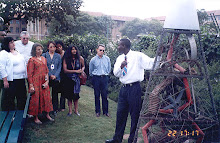
On 25th May, Africa Day is celebrated in Africa and all over the world. I first celebrated it in May 2019, when I attended “Google’s Africa Day Outreach: Creative Bootcamp” at Nairobi Garage.
I'm in the purple checked sweater.
In 2023, ROFFEKE celebrated Africa Day with Africans Rising under the theme of “Borderless Africa”. The ROFFEKE Borderless Africa YouTube playlist features short films and music videos submitted to ROFFEKE since 2015, that have been created by or feature Africans in the continent or in the diaspora.
The Kilimanjaro Declaration 2.0 was adopted on 31st August 2022 in Arusha Tanzania. In the declaration, the 2022 All African Movement Assembly (AAMA) declared that:
1.Africa is a rich continent, and her wealth belongs to all her people. We commit to fight for economic justice qualified by socio-political development.
2.Africans have a diverse, rich, and powerful heritage that is important to heal ourselves and repair the damage done by neoliberalism to our humanity and environment. Being Africans and embracing African philosophies such as “Ubuntu” are sources of our pride.
3.African youth and women are a critical foundation for building the success of our continent and must play a central role in building the Africa We Want for Unity, Justice, Peace and Dignity. We are committed to building an intergenerational dialogue and strategic collaboration with our elders to advance a shared vision.
4.Africa’s diaspora, whether displaced through slavery and colonialism or part of modern-day migration occasioned by political, economic and climate change factors, is part of Africa’s history and future. We commit to ensure that their reservoir of knowledge, skills, resources and passion are part of advancing Africa.
Also on Africa Day, I attended (virtually) an event titled “The African Diaspora, Trade, and Investment Symposium”. The event’s YouTube video description: “This #AfricaDay, OECD Development Centre and Minnesota Africans United are gathering investors, policy makers and diasporic groups, to share examples of the many ways African #diasporas engage in private sector development to the benefit of both “mother” and “new” home countries.”
The next day, on 26th May, I attended Mastercard Foundation’s EdTech event that was held at iHub. In the past, iHub has played a role in helping ROFFEKE achieve its mission of promoting rock music in Kenya via film. In September 2015, ROFFEKE held a screening of short films and music videos at iHub. Read some of the attendees' comments HERE.
“Why is ROFFEKE – a rock film festival – interested in education? There are many reasons but in short, education is part of the objectives of ROFFEKE. Also, education plays a crucial role in the achievement of ROFFEKE’s mission: to promote rock music in Kenya via film by dispelling rock ‘n’ roll myths and misconceptions.”
The main objectives of ROFFEKE are:
1.To showcase local and international rock ‘n’ roll films and music videos for the purposes of education and entertainment.
2.To organize workshops, forums and seminars related to various aspects of rock music and the film industry.
3.To provide a platform for emerging and established, local and international rock bands.
The Mastercard Foundation Edtech event was inspiring. I sat through the first few presentations by talented Edtech startups namely Snapplify, Easy Elimu, Funky Science, Silabu, Elewa, Arifu and Virtual Essence. Clearly, a lot is being done by Kenyan entrepreneurs to tackle the challenges of education in Kenya and Africa.
Later, as I was reflecting on all these events, I could not help but connect the dots. One speaker at The African Diaspora Trade and Investment Symposium, Christopher Brooks, is a venture capitalist of African descent with a passion for Africa. He pointed out that he was on the lookout for projects he could invest in. I strongly believe that the projects I saw during the Mastercard Foundation Edtech event are ripe for this kind of Afro-cenric investment. Christopher said:
“I have a bias when it comes to this kind of conversation. We invest in tech. We invest in tech specifically because it scales quickly, creates enormous value quickly and then when there is some sort of liquidity event or exit, you can redeploy the gains and it just becomes this ever-expanding economic pie. I’m a big believer in tech. Africa is actually producing right now some of the world’s best innovative technologies. (From minute 49:22 to 49:50)
At this African Diaspora Trade and Investment Symposium, I was inspired by all that the diaspora is doing to help Africa. However, as an African in Africa who sees a lot of opportunities in the “motherland” I begun feeling uncomfortable with the narrative of Africans always being recipients of aid, even if it is from fellow Africans. I asked via the Zoom Q and A feature: How can Africans also help Africans in the diaspora?
In the chat, I made a small contribution that challenged the narrative that African youth only want government jobs. While it is true that many Africans look to government jobs due to the stability they offer, many African youth are entrepreneurial, as evidenced by the Mastercard Foundation Edtech event. I pointed out in the chat that many Africans are interested in and are active in the creative economy.
“The Mystery of Capital: Why Capitalism triumphs in the West and fails everywhere else” by Hernando de Soto was mentioned by Christopher Brooks. He said: “What I learned as I read that book was that talent is equally distributed among the human population but opportunity is not.” (From minute 40: 49 to 41:08)
I would argue that even this lack of many opportunities in Africa…is actually an opportunity!
Christopher Brooks went on to say: “Our venture capital firm has the goal of creating a world where transformation capital is accessible to all not just to some so that is how we invest. We find really great entrepreneurs of colour with really great ideas and we deploy strategic capital in the right amount at the right time to help those entrepreneurs scale their businesses and eventually exit their businesses creating brand new economic value." (From minute 42:52 to 43:17)
He also said: “I wanna actually go a couple of layers deeper than the current conversation. When Africans were imported to America as slaves, we were told, we black people, were told that we were not fully human. America told black people that they were three-fifths human, and that meta-narrative of less than human has been indoctrinated in people throughout American history."
"So one of the things that we must do, we all must, even members of the diaspora, must examine our worldview and ask ourselves, do we really believe that talent is equally distributed across the world, because in many nations, especially developed nations, we’ve been taught that talent is not equally distributed. We’ve taken this darwinistic approach, survival of the fittest, and we’ve basically said that the developed nations are the fittest, the nations that are developing or less developed are not as fit, are not as smart, are not as good, and that is just diabolical and patently untrue. I think the root, the foundation of any solution that has to do with the continent of Africa must be, Africans are brilliant. Africans are capable. Africans are investment-ready. Africans have the best solutions for Africa. If we really believe that, even those of us who are members of the diaspora, we will continue to tap into the genius of the African people that live on the African continent and we will build a better society because it will be deeply informed by those who live and breathe the African air every single day. That’s how we at Brown Venture Group and that’s how I as an individual investor and practitioner look at the world and that’s how I’m approaching the work. The best solutions for Africa come from Africa.” - Christopher Brooks. (From minute 1:06:14 to 1:08:00)


 Posts
Posts